Deconstructing the "Dud Loaf": The Science Your Bread Machine Manual Forgot
Update on Nov. 9, 2025, 1:53 p.m.
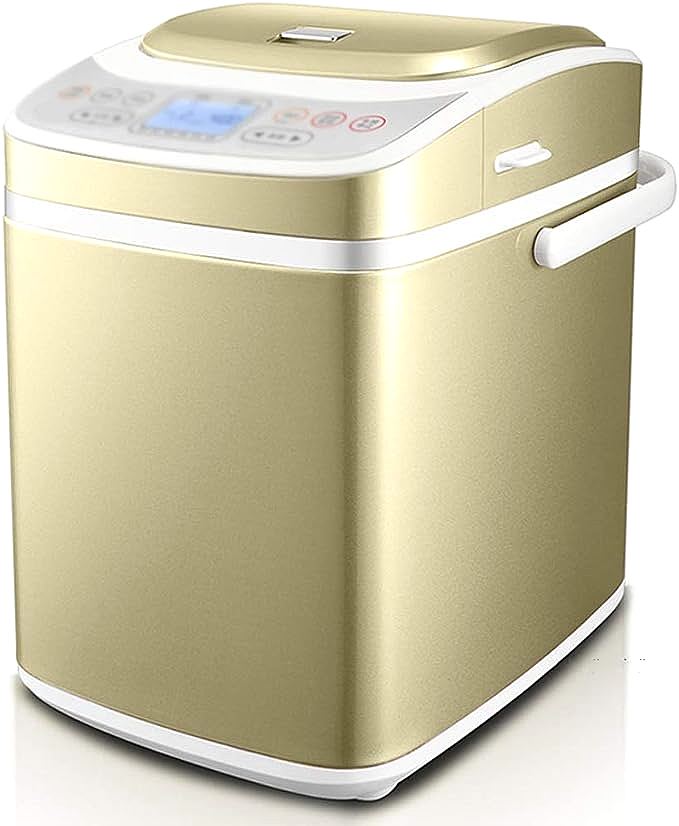
It is the most promising and most frustrating appliance in the modern kitchen. The bread machine, sold on the dream of “dump-and-go” baking, promises to deliver the aroma of a fresh, healthy loaf with the press of a button.
The reality, as countless user reviews for many models lament, is often a “dud loaf.” You follow the “useless” recipe book to the gram, only to be rewarded with a dense, gummy, or collapsed brick. One user, reflecting on their experience, admitted their “first loaf was a fail.” Another summed up the frustration: “No instructions for this machine.”
The problem is that the appliance isn’t magic. It is a “black box” container for a complex scientific process. The manual tells you what buttons to press, but never why.
When a loaf fails, it’s not the machine’s fault; it’s a failure at one of three critical scientific stages. To master the machine, you must first deconstruct the science it’s trying to automate.

1. The First Failure Point: The Knead (Gluten Development)
Bread’s structure comes from gluten. When the flour’s two proteins (glutenin and gliadin) meet water, they form chains. The physical act of kneading organizes these chains into a strong, elastic net. This “gluten net” is what traps the CO2 gas produced by the yeast, allowing the bread to rise.
Why It Fails: * Improper Hydration: As one user astutely noted, “dud” loaves are often “because the dough is too wet or too dry.” If too dry, the gluten net is underdeveloped and stiff. If too wet, it’s weak and soupy. * Weak Motor: Kneading dense dough (like whole wheat) requires significant torque. A weak motor can’t properly stretch and align the gluten, resulting in a dense, “brick-like” loaf. * Poor Timing: Add-ins like nuts and fruit are destructive. If added too early, their sharp edges shred the delicate gluten strands as they form, guaranteeing a collapsed loaf.
The Engineering Solution:
This is where hardware sophistication matters. A machine’s motor isn’t just for noise (or lack thereof); a high-power, low-noise DC motor (rated under 40 dB in some models) provides the consistent torque needed to develop gluten in even the most challenging doughs.
Furthermore, an automatic nut dispenser isn’t a luxury; it’s a structural necessity. This device, as seen in models like the KBS MBF-011, holds the nuts and fruits until after the primary gluten development is complete. It then releases them to be gently folded in, not shredded by the entire kneading cycle.

2. The Second Failure Point: The Fermentation (The Yeast’s Environment)
If gluten is the “balloon,” yeast provides the “breath.” Yeast is a living organism that consumes sugar and releases CO2 gas. This gas inflates the gluten net, causing the dough to rise (ferment).
Why It Fails: * Temperature: Yeast is a diva. It is most active in a very narrow temperature range (75-95°F / 24-35°C). If the machine’s proofing cycle is too cold, the yeast is sluggish, and the rise is poor. If it’s too hot (over 140°F / 60°C), the yeast dies. * “Dumping” Error: The “dump-and-go” method fails if the yeast comes into direct contact with salt (which can kill it) or if the liquid is too hot, killing it on impact. * Wrong Program: Users are often baffled by the 17+ programs. A “Sourdough” program is chemically different from a “Basic” one. Sourdough uses wild yeast, which requires a longer, slower, and often cooler fermentation period to develop its flavor. A “Basic” program is timed for the “jackrabbit” speed of commercial yeast and will not work for a sourdough starter.
The Engineering Solution:
A smart machine controls this environment. It’s not just a timer; it’s a thermostat. Advanced programs, like those for sourdough, are algorithmically designed to hold the specific temperature profiles that different yeast cultures require. This is why some users find their sourdough setting “does a very good job”—the machine is correctly managing the yeast’s environment.
3. The Third Failure Point: The Bake (The Final Transformation)
The final stage is where two things must happen:
1. Starch Gelatinization: The heat must penetrate the center of the loaf, causing the starch granules to burst and set, forming the soft, moist “crumb.”
2. Maillard Reaction: The heat on the outside of the loaf must brown the crust, creating hundreds of new flavor compounds.
Why It Fails:
The most common bread machine failure is uneven heat. Cheaper machines have only one heating element at the bottom. This results in the classic “pale top, burnt bottom” loaf. The bottom element scorches the base while the top of the loaf never gets hot enough for the Maillard reaction to occur, leaving it pale, gummy, and anemic.
The Engineering Solution:
This is, perhaps, the most important hardware upgrade. Premium machines, such as the 710W KBS model, now employ Dual Heaters—one at the bottom and one at the top.
This design completely changes the baking physics. It transforms the machine from a simple “baker” into a miniature convection oven. * The bottom heater provides the conductive heat for oven spring and to ensure the crumb is fully cooked (starch gelatinization). * The top heater provides direct, radiant heat to the crust, driving the Maillard reaction and ensuring a “perfect browning” and an even, golden loaf. As multiple users note, “The double heating elements are great.”

The Overlooked Factor: Material Science and Health
Finally, the pan itself is part of the process. Users are increasingly, and rightly, concerned with the materials touching their food, with many switching to homemade bread to avoid additives.
Why It Fails:
Older non-stick coatings (Teflon/PTFE) can scratch and degrade, causing users to worry about health (BPA/PTFE-free) and causing the bread to stick, which ruins the loaf.
The Engineering Solution:
The shift to a non-stick ceramic pan is a deliberate choice. As one user called it, “the best thing about this bread maker.” Ceramic provides excellent, even heat distribution (preventing hot spots) and is chemically inert, addressing the health-conscious user’s primary motivation. It also ensures an “effortless release” of the finished loaf, protecting the structure that you spent three hours building.
Conclusion: From “Black Box” to “Toolkit”
Your bread machine is not a magic box. It is a robotic baker designed to control the precise, scientific variables of kneading, fermentation, and baking.
When you get a “dud loaf,” the “useless” manual is no help. But by understanding the science, you can become a diagnostician. * Is it a dense brick? Your kneading failed (check hydration) or your fermentation failed (check yeast, temperature). * Is it pale and gummy? Your baking failed (your machine lacks the hardware, like a top heater, for a proper Maillard reaction).
Appliances like the KBS MBF-011 are not just “17-in-1” gimmicks; they are sophisticated toolkits. They represent the engineering solutions (dual heaters, ceramic pans, smart programs, auto-dispensers) designed to solve the most common failure points of baking science. By understanding this, you can finally move from “dump-and-pray” to “dump-and-diagnose,” and turn that black box into a reliable partner.