The Toasting Trilemma: Why a Perfect Slice is Hard, and How Modern Toasters Solve It
Update on Nov. 9, 2025, 4:30 p.m.
There is a quiet, almost magical, transformation that happens in our kitchens each morning. A humble slice of bread, soft and unassuming, enters a warm, glowing chamber and emerges as something entirely new: a crisp, golden-brown canvas for butter, jam, or avocado. It’s a daily ritual so common we often overlook the fascinating interplay of science and engineering required to get it just right.
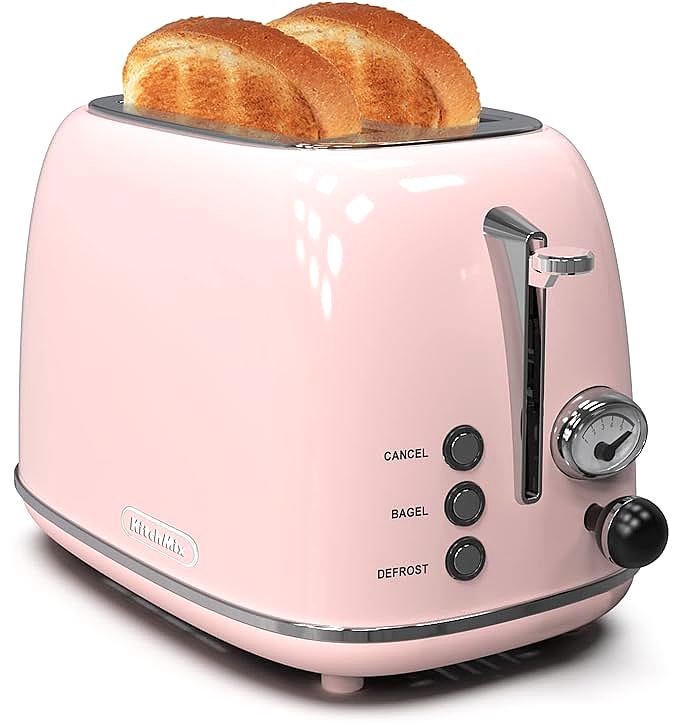
Yet, as one user review poignantly asks, “Who would think finding a toaster that actually toasted bread properly would be so difficult?” This question strikes at the heart of the great toasting challenge. Today, we’ll delve into the science behind that perfect slice, using the charming KITCHMIX WT-340A 4 Slice Retro Toaster as our case study to explore how modern design tackles the age-old problems of heat, time, and uniformity.

The Trilemma of Toast: Heat, Time, and Uniformity
At its core, toasting is a balancing act between three fundamental forces. Getting this “toasting trilemma” right is the singular goal of every toaster ever designed.
- Heat (The Physics): How do you generate and transfer intense heat quickly and efficiently?
- Time (The Chemistry): How do you control the duration of that heat to achieve the perfect chemical reaction for color and flavor?
- Uniformity (The Engineering): How do you ensure every square millimeter of the bread receives an equal amount of that heat for the same amount of time?
Let’s see how a modern appliance like the KITCHMIX WT-340A addresses each of these challenges.
Pillar 1: The Physics of the Glow - Powering the Transformation
The magic of toasting begins with infrared radiation. The glowing wires inside a toaster are made from a nickel-chromium alloy called nichrome, a material brilliant at resisting heat and electricity. When you press the lever down, a powerful current flows through these wires. The KITCHMIX WT-340A packs a robust 1650-watt engine. This isn’t just a number; it dictates the speed and intensity of the heat. Higher wattage allows the nichrome elements to reach their optimal toasting temperature almost instantly, radiating intense infrared energy that is absorbed by the surface of the bread.
This rapid, radiant heating is crucial. It begins to drive moisture from the bread’s surface, the first step in creating that signature crispness, while simultaneously kickstarting the chemical reactions responsible for flavor and color.
Pillar 2: The Chemistry of the Crust - Dialing in Deliciousness
As the bread’s surface temperature climbs past 280°F (140°C), a magnificent chemical cascade known as the Maillard reaction begins. This is the reaction between amino acids and sugars in the flour, and it’s responsible for creating hundreds of new, complex flavor and aroma compounds—the nutty, roasted, savory notes we crave. As temperatures rise even higher, caramelization of the sugars themselves adds deeper color and richer, slightly sweeter notes.
The 6-level adjustable browning dial on the KITCHMIX is your control panel for these very reactions. Each setting corresponds to a specific amount of time the 1650-watt elements will radiate heat. * Low Settings (1-2): A short duration, initiating a gentle Maillard reaction for a light golden hue and soft texture. * Mid Settings (3-4): The sweet spot for classic toast, allowing for a full, balanced development of Maillard and caramelization flavors. * High Settings (5-6): A longer cycle that pushes the reactions further, creating a dark, crunchy crust with intense, robust flavors.
However, as one user astutely noted, the number on the dial isn’t always a perfect predictor. “I have to turn the dial close to a 3 to get a light to medium toast.” This isn’t necessarily a flaw but a lesson in food science: different breads react differently. A high-sugar brioche will brown much faster than a rustic sourdough at the same setting. The six levels give you the precision to find the perfect setting for your favorite bread.

Pillar 3: The Engineering of Evenness - Chasing the Uniform Toast
This is the final, and often most difficult, piece of the puzzle. A user review captured the universal frustration perfectly: “…the toasting portion of the toaster leaves the bottom of the bread untoasted.” This is a classic problem rooted in physics.
The KITCHMIX WT-340A employs several engineering solutions to combat this inherent unevenness: * 1.5-Inch Extra-Wide Slots: Thicker slices of bread or bagels in a narrow slot are pressed too close to the heating elements, causing scorching in some spots while others remain pale. The wider slots allow for more space, promoting better circulation of hot air (convection) and more uniform exposure to infrared radiation. * Self-Centering Guides (Implied): Most modern toasters include internal wire cages that gently grip the bread slice as it’s lowered, holding it equidistant from the heating elements on both sides. This is crucial for even side-to-side toasting. * “360° Baking Mode”: This marketing term speaks to the strategic placement and design of the heating elements themselves. The goal is to create a field of radiation that covers the entire bread surface as evenly as possible. However, the “untoasted bottom” issue suggests that, like in many toasters, heat distribution may not be perfectly uniform, a persistent challenge for engineers.
Solving the Breakfast Bottleneck: The Genius of Dual Controls
In a busy household, toast preferences can be a point of contention. One person wants a light toast, the next a dark bagel. The KITCHMIX WT-340A’s most user-centric feature is its dual independent control panels. This design effectively turns one 4-slice toaster into two separate 2-slice toasters. Each panel controls its own pair of slots, with its own browning dial and function buttons.
This means you can simultaneously toast two slices to a delicate golden-brown on setting ‘2’ while toasting two bagel halves to a deep, crispy brown on setting ‘5’. It’s a simple but brilliant solution to a common social friction point in the kitchen, allowing for “less time, more choices” and a more harmonious start to the day.

The Final Polish: Thoughtful Features for a Flawless Experience
Beyond the core science, several design elements elevate the user experience from functional to delightful. The high-lift lever is a simple yet crucial safety and convenience feature, allowing you to easily retrieve smaller items like English muffins without risking burnt fingers.
The toaster’s body is made of food-grade 18/8 stainless steel. The “18/8” denotes a composition of 18% chromium (for rust and corrosion resistance) and 8% nickel (for durability and luster). This ensures the appliance is not only durable and easy to clean but also non-reactive, meaning it won’t impart any unwanted flavors to your food.
Finally, the removable crumb trays are essential for both cleanliness and safety. Accumulated crumbs near the hot elements can be a fire hazard. The dual trays make the vital task of regular cleaning quick and effortless.
In the end, the KITCHMIX WT-340A is more than just its charming retro facade. It’s a thoughtfully engineered device that attempts to solve the fundamental challenges of toasting. It puts the control of complex chemical reactions at your fingertips, addresses the physics of heat distribution, and solves the practical problems of a multi-person household. While the quest for a toaster that is absolutely perfect in every scenario remains the holy grail of kitchen appliance design, understanding the science behind the process empowers you to work with your toaster, making informed adjustments to achieve that one simple, deeply satisfying goal: your perfect slice of toast.