Amazon Basics BM1349-UL-B Bread Maker: Bake Perfect Loaves with Ease

AmazonBasics 2 Pound Bread Maker
My bread maker doesn't make bread. It simulates an ecosystem. And in its failures, it reveals the beautiful, chaotic science we've spent 10,000 years trying to control.
The loaf stands on the cooling rack, a monument to a minor, everyday miracle. Its scent fills my kitchen with a primal warmth, an aroma so deeply coded into our civilizational DNA that it feels like a memory. It is, by most metrics, a success. The crust is an even, burnished gold. The crumb, when I eventually slice into it, will be soft and yielding.
Yet, it’s… odd. It’s too tall, too symmetrical, with a perfectly rectangular profile that looks less like something from a rustic bakery and more like a prop from a science-fiction film. A slice from its center won’t fit in my toaster, a small but persistent insult from the world of standardized appliance design. This strange, geometrically perfect loaf was born in my Amazon Basics bread machine, a humble, unassuming black box that promises artisanal results with industrial efficiency.
And in that promise, and its slightly imperfect delivery, lies a story far grander than breakfast. It’s a story about our 10,000-year-long quest to tame the wild, not in forests or fields, but on a microscopic scale. My bread maker, you see, doesn’t actually make anything. It is a miniature biosphere, a climate-controlled stage on which a drama of biology and chemistry, ancient and untamed, is allowed to unfold in a predictable way.

We didn't invent bread. It’s more accurate to say we entered into a partnership. Long before we understood the germ theory of disease, before we had a name for the microorganisms that surround us, our ancestors stumbled into an alliance with a kingdom of invisible life. The first leavened bread was likely a happy accident—a forgotten gruel of grain and water, left to the open air, that began to bubble and swell, colonized by wild yeasts that feasted on its simple sugars.
What happened next was arguably humanity’s first act of biotechnology. By saving a piece of this living dough to start the next batch, we began the slow, unconscious process of domesticating Saccharomyces cerevisiae. We selected for strains that were robust, that produced pleasant flavors, and that reliably inflated our dough with their metabolic breath—carbon dioxide. The wild, unpredictable magic of fermentation was being brought indoors, slowly shepherded from a random act of nature into a repeatable craft.
This ancient bargain is reenacted every time I use my machine. Inside its non-stick pan, I am assembling a carefully balanced ecosystem. But today’s protagonist is no wildling; it is a highly refined, commercially produced yeast, the result of a century of industrial selection. It is a microbial partner bred for performance and predictability, a far cry from its wild ancestors. The machine’s first act is to create the perfect incubator, gently warming the water to awaken this dormant life—a digital sun coaxing forth a controlled spring.

But yeast is only one of the wild things we must wrangle. The very structure of bread comes from taming a chaotic force at the molecular level. Wheat flour holds two proteins, glutenin and gliadin. Dry, they are dormant. But add water, and they unfurl and cling to each other, creating a tangled, sticky mess.
This is where the machine’s paddle begins its relentless, programmed dance. For twenty minutes, it mimics the ancient rhythm of a baker’s hands—folding, stretching, turning. This isn’t just mixing; it’s an act of molecular engineering. The mechanical force untangles the protein chains and aligns them, weaving them into a vast, elastic network of gluten. It is this web, strong yet supple, that will trap the carbon dioxide produced by the yeast, allowing the dough to rise into a light, airy structure. The machine performs this task with a quiet, tireless consistency that my own arms could never match. It is taming chaos with a motor and an algorithm.
Then comes the final, most transformative act of alchemy: heat. As the internal temperature soars, the yeast has one last, frantic burst of activity before perishing. The gluten network solidifies, and a complex chemical cascade known as the Maillard reaction begins. First described by the French chemist Louis-Camille Maillard in the early 20th century, this reaction between amino acids and sugars is the source of almost every delicious browning we know—from the sear on a steak to the roast of a coffee bean.
It is not one reaction, but hundreds, creating a symphony of flavor and aroma compounds. My machine allows me a semblance of control over this beautiful chaos with a simple button: Crust Color. Light, Medium, Dark. It’s a deceptively simple interface for a profoundly complex process. By selecting ‘Dark,’ I am instructing my countertop laboratory to push the Maillard reaction further, to flirt with the edge of scorching in pursuit of a deeper, more robust flavor.

So, with all this programmed precision—this carefully managed ecosystem, this molecular shepherding, this controlled alchemy—why is my loaf so strange?
The answer lies in the machine itself. The vertical loaf pan, the source of my toaster’s frustration, is a deliberate compromise. It’s a design choice that prioritizes a small countertop footprint over the sprawling, rustic form of a traditional hearth-baked loaf. The shape of my bread is a physical manifestation of a modern trade-off: the surrender of traditional form for the sake of spatial efficiency. It is the ghost of my small kitchen’s design limitations, baked directly into my food.
This sense of a negotiated reality is everywhere if you look for it. One of the most common complaints in the machine’s reviews is about its “lousy manual.” This is fascinating. We have a device that automates a process once considered a high art, yet it fails at the simple task of communicating knowledge. The machine becomes a black box. We know what goes in and what comes out, but the process between is opaque, hidden behind presets.
One brilliant reviewer described their solution: they only use the machine for its “Dough” cycle—leveraging its tireless power for the hard work of kneading and the first rise. Then, they take the perfected dough, shape it by hand, and bake it in their conventional oven. This isn't a rejection of the technology. It’s a new bargain. It’s a reclamation of the final, most creative step, a refusal to be a passive recipient of the machine’s output. It’s an acknowledgment that automation is a powerful tool, but not a replacement for understanding.
That is why I’ve come to appreciate my oddly shaped loaf. It’s not a symbol of failure, but a testament to the entire, sprawling story. This simple Amazon Basics appliance on my counter is a portal. It connects me to the first farmers of the Fertile Crescent, to the labs of 20th-century chemists, and to the quiet, ongoing negotiation between human ingenuity and the beautiful, untamable forces of nature. The goal, I’ve realized, was never just to get a perfect loaf of bread. It was to be given the freedom to understand the beautiful, magnificent chaos in every single bite.
AmazonBasics 2 Pound Bread Maker
Related Essays
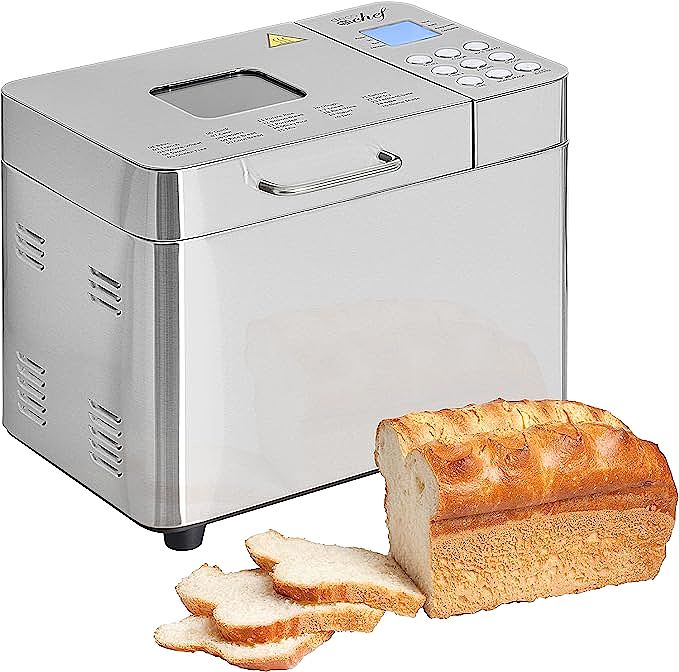
Deco Chef BMSTS01 Bread Maker: Baking Science and Delicious Bread at Home

The Modern Bread Machine Paradox: A Deep Dive Into What Truly Matters

The Engineering of Automated Dough Science: Deconstructing Modern Bread Machines

Russell Hobbs 18036-56 Bread Maker: Fresh, Homemade Bread Made Easy

Generic SMLJLQ Mini Bread Maker: Baking Science Made Easy

Generic SMLJLQ Bread Machine: Fresh, Healthy, Homemade Bread Made Easy

Panasonic SD-MT3-W Home Bakery: Bake Perfect Japanese-Style Bread at Home

The 800-Degree Question: Deconstructing the Science of Pizzeria-Style Pizza at Home

Breadman TR520 - A Decent Bread Machine for Beginners
