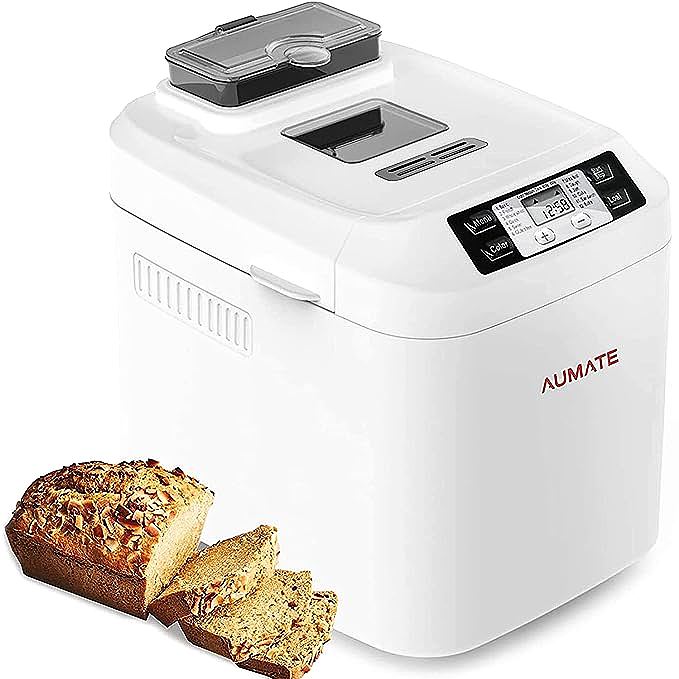
The Baker's Trinity: Deconstructing the SAKI 3LB Large Capacity Bread Maker
Update on Nov. 9, 2025, 5:15 p.m.
The aroma of homemade bread is a universal comfort, but achieving that perfect, artisan-quality loaf at home, especially in large quantities, presents a significant challenge. For families and avid bakers, the quest often leads beyond entry-level appliances to more robust, thoughtfully engineered machines. The SAKI SK-BM8910 3 LB Large Bread Maker is one such appliance, positioning itself as a professional-grade tool for the home kitchen.
But what truly elevates a bread machine from a simple convenience to a high-performance baking partner? It’s not just one feature, but a synergistic system of power, mechanics, and materials science. Using the SAKI bread maker as a case study, let’s deconstruct this “baker’s trinity” to understand the science that separates a good loaf from a great one.

The Power Core: A System of Stability and Strength
The primary challenge of large-batch baking is managing a large, heavy mass of dough. The SAKI machine is engineered around this challenge with a powerful and stable core system.
The 850-Watt High-Torque Motor: Kneading is the process of developing gluten, the protein network that gives bread its structure. A large, 3-pound dough requires immense and sustained mechanical force to ensure this network is developed properly. The SAKI’s 850W motor provides the high torque needed to drive its paddles through this dense mass without straining or overheating. As the manufacturer notes, “More program does not mean better bread but more power means better bread.” This power ensures that even heavy, whole-grain loaves are kneaded thoroughly, a key factor for a soft texture and a high rise.
The Anchor: A 16.5-Pound Body: This powerful motor generates a significant reaction force. In accordance with Newton’s Third Law, as the paddles push the dough, the dough pushes back on the machine. In lighter-weight models, this can cause the appliance to vibrate and “walk” across the counter. The SAKI’s substantial 16.5-pound weight serves as a crucial anchor. This mass provides the inertia needed to absorb the motor’s torque and remain stable during even the most vigorous kneading cycles. As one user noted, the SAKI is “extremely quiet w/ the 850 watt high torque motor which is a big plus and I haven’t noticed any movement at all during the kneading process.” This demonstrates a deliberate engineering choice where weight is leveraged as a key component of a stable, high-performance system.
The Mechanical Heart: The Advantage of Dual Kneading Paddles
For a large, horizontally oriented loaf, a single kneading paddle is often inadequate. It can struggle to reach the corners of the pan, leaving pockets of unmixed flour and resulting in an uneven gluten structure.
The SAKI machine’s dual kneading paddles are the mechanical heart of its large-capacity design. Working in tandem, they provide superior coverage of the entire bread pan. This system creates a more complex and efficient kneading pattern, more closely mimicking the stretching, folding, and turning action of a skilled baker. This ensures that the entire dough mass is worked evenly, leading to a homogenous mix and a consistently developed gluten network throughout the loaf—a critical factor for the uniform crumb structure expected in a 3-pound loaf.

The Crucible of Baking: The Science of the Ceramic Pan
Perhaps the most unique feature of the SAKI bread maker is its non-stick ceramic bread pan. While many bread makers use standard PTFE-based non-stick coatings, SAKI emphasizes ceramic as “the healthiest way to bake bread with no chemicals.” Beyond the health-conscious appeal, this material choice has significant implications for baking science.
Ceramic is prized for its excellent thermal properties: * Even Heat Distribution: Ceramic has high thermal conductivity and diffusivity, meaning it heats up smoothly and distributes that heat evenly across its surface. This minimizes “hot spots” that can cause the bottom or sides of a loaf to burn while the inside remains undercooked. * Superior Heat Retention: Once at temperature, ceramic holds heat consistently, creating a stable baking environment that promotes a uniform crumb and a perfectly formed crust.
The result is a baking environment that behaves more like a traditional baker’s oven, where radiant heat envelops the dough evenly. This is crucial for large loaves, which require thorough heat penetration to cook the center without scorching the exterior. The non-stick properties also ensure the finished loaf releases cleanly, a feature users rate highly.
The Browning Paradox: When the Top Stays Pale
Despite the excellent heat distribution of the ceramic pan, one user noted a common issue with many horizontal bread makers: “…the top of the loaf doesn’t brown within the cooking time.” This is not necessarily a flaw in the machine but a consequence of its design.
In a countertop oven, the primary heat source is the elements surrounding the pan. The top of the loaf is furthest from these elements and relies on a combination of radiant heat from the lid and circulating hot air (convection) to brown. This is often less efficient than the direct heat the sides and bottom receive.
Interestingly, the user discovered a clever solution: “The third one I left in through the post-bake warming cycle and it finally came out a lovely shade of brown on top.” This is a perfect example of a user leveraging the machine’s features to overcome a physical limitation. The Keep Warm function, by providing an extended period of gentle, dry heat, allowed enough time for the Maillard reaction and caramelization to complete on the top crust. It’s a testament to understanding your specific appliance and using its full suite of tools to achieve your desired result.

The Human Element: When Service Completes the System
For a smaller business brand competing against established giants, the product itself is only half the equation. The SAKI bread maker is backed by a 2-Year Replacement Warranty, a bold statement of confidence in their product’s durability.
User reviews reinforce this, telling a story of responsive and effective customer service. One user who received a noisy initial unit reported that the manufacturer “responded within 24 hours” and promptly offered a replacement, which was “quiet” and worked perfectly. Another user whose first unit malfunctioned and even started to melt a plastic component noted, “They are shipping another one right away,” and later followed up: “The second unit works perfect.”
This “human software”—the reliable customer support and robust warranty—is a critical part of the overall value proposition. It provides a safety net for consumers, assuring them that any potential manufacturing defects or early failures will be addressed, transforming a potentially negative experience into a positive affirmation of the company’s commitment to its customers.
In the end, the SAKI SK-BM8910 presents a compelling case for a systems-based approach to appliance design. The powerful motor, substantial weight, dual paddles, and ceramic pan are not just a list of features; they are an integrated engineering solution designed to master the specific challenges of large-capacity home baking. While it may have its own quirks, like any appliance, its strong core performance, coupled with a company that stands firmly behind its product, makes it a formidable tool for any serious home baker looking to elevate their craft.