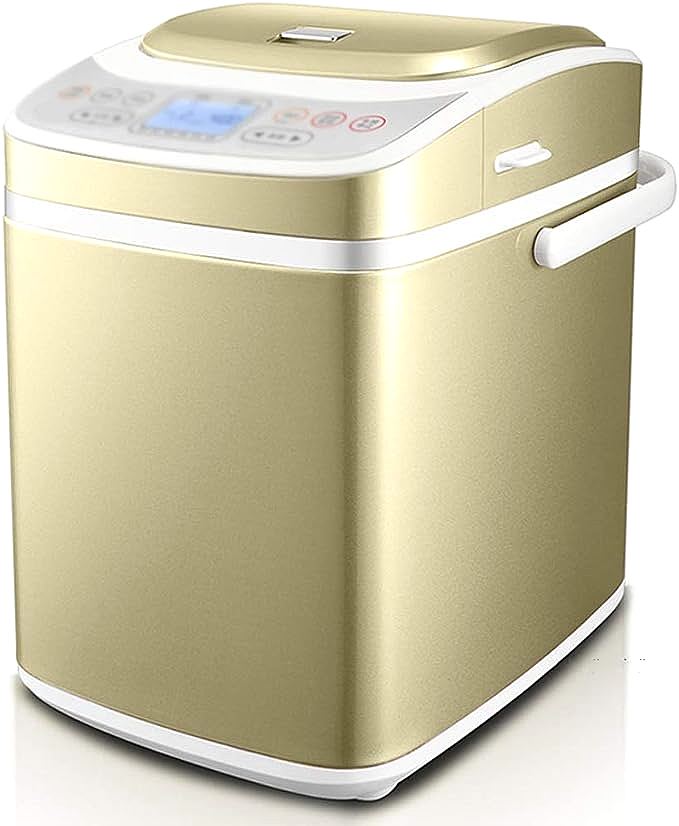
Ztjjg CZDYUF 220V Home Bread Machine: Fresh, Homemade Bread Made Easy
Update on Sept. 22, 2025, 10:15 a.m.
Your loaf of bread is a marvel of biology, chemistry, and physics. Let’s slice into the billion-year-old story that a modern appliance tries to tell.
The sound is the first sign. A subtle crackling, the crisp shell of the crust contracting as it meets the cool air. Then comes the aroma—a complex perfume of toasted grain, sweet caramel, and something deeply, primordially comforting. When you finally slice into it, the steam ghosts upwards, revealing a soft, airy architecture within.
This transformation, from a humble slurry of flour and water into a life-sustaining loaf, feels like a minor miracle. For millennia, we called it art, tradition, even magic. But it’s none of those. It’s science. It’s a carefully orchestrated performance of biology, chemistry, and physics, with players who have been rehearsing their roles for over a billion years.
And while we can now delegate the entire production to a quiet, unassuming box on our countertop, understanding the script it follows doesn’t diminish the magic. It deepens it.

The Unseen Architect: Gluten’s Molecular Ballet
Let’s start with the soul of bread: its structure. In recent years, gluten has become a nutritional villain in many circles, a word whispered with caution. But from a baker’s and a scientist’s perspective, gluten is a superhero. It’s the molecular architect responsible for bread’s magnificent rise and satisfying chew.
Inside every grain of wheat flour lie two dormant proteins: glutenin and gliadin. On their own, they are unremarkable. But the moment you add water, an intricate ballet begins. The water molecules hydrate the proteins, allowing them to unfurl and link together, forming an entirely new entity: gluten.
But this nascent network is a tangled, chaotic mess. This is where kneading comes in. The pushing, folding, and stretching isn’t just about mixing ingredients; it’s a physical process of molecular engineering. You are, in essence, coaching a microscopic gymnastics team. Each knead untangles the protein strands and aligns them into a highly ordered, elastic web.
Imagine millions of tiny, interconnected trampolines. That’s the gluten matrix. Its purpose is singular and crucial: to be strong and flexible enough to trap the gases that will soon be produced, allowing the dough to inflate like a balloon. Without this perfectly developed structure, you don’t have bread; you have a brick.

The Ancient Engine: Our Alliance with Yeast
Once the stage is set, it’s time for the lead actor to emerge from its slumber. We call it yeast, but its scientific name is Saccharomyces cerevisiae—a single-celled fungus that is one of humanity’s oldest domesticated partners. For centuries, we used it without understanding it, relying on the “magic” of a bubbling sourdough starter passed down through generations. It wasn’t until Louis Pasteur in the 19th century that we finally proved this “magic” was the work of a living organism.
When introduced to the warm, moist, sugar-rich environment of the dough, yeast awakens and begins to feast. In this cozy, oxygen-poor environment, it performs anaerobic respiration. It consumes sugars and, as a byproduct, releases ethanol (which mostly bakes off) and countless tiny bubbles of carbon dioxide gas.
This is the leavening. The CO₂ gas, exhaled by our microbial allies, is captured by the gluten network we so carefully constructed. The dough begins to swell and rise, alive with the quiet work of millions of microscopic engines. This symbiotic relationship—we provide the home, yeast provides the lift—is a cornerstone of civilization, a partnership that predates written history.

The Alchemist’s Fire: The Maillard Reaction’s Flavor Symphony
The dough is now risen, a pale, pillowy mass full of potential. The final act of transformation requires the brutal, creative force of heat. Baking is not merely drying; it’s a crucible where new flavors, colors, and textures are forged through intense chemistry.
The star of this show is the Maillard reaction, named after French chemist Louis-Camille Maillard. It is, perhaps, the single most important reaction in the culinary world. It’s not burning. It’s not caramelization (which is simply the browning of sugar). The Maillard reaction is a far more complex and delicious affair between amino acids (the building blocks of proteins) and reducing sugars.
As the surface of the dough heats past 140°C (285°F), these compounds begin a chaotic, chain-reaction dance. They break apart and recombine, creating hundreds of new, volatile molecules. These molecules are what we perceive as the rich, savory, toasty, and nutty flavors of the crust. It’s the same reaction that gives a seared steak its savory crust, roasted coffee its deep aroma, and fried onions their sweetness. It is the alchemy of flavor.
Meanwhile, inside the loaf, a different process called starch gelatinization is taking place. The starch granules absorb the remaining water, swell up, and burst, forming a soft, stable, sponge-like structure that we call the crumb.
The Modern Crucible and a Curious Case Study
Today, we can contain this entire epic—the molecular engineering, the microbial respiration, the chemical alchemy—within a single appliance. A modern bread machine is programmed to be the perfect conductor for this scientific orchestra. It kneads for the right duration to build the gluten, provides the perfect temperature for the yeast to thrive, and then applies precise heat to trigger the Maillard reaction.
It’s a marvel of automation. Consider, for a moment, a product like the Ztjjg CZDYUF 220V Home Bread Machine. It exists as a testament to this automation. But it also serves as a fascinating case study in how deep science collides with the practical realities of engineering, economics, and evidence.
Its first curious trait is its 220V rating. For anyone in North America, where the standard is 120V, this is an immediate barrier. This isn’t just a matter of a different plug shape; it’s a fundamentally different electrical standard. This schism in global power grids is a ghost of the “War of the Currents” fought between Thomas Edison (advocating for DC power) and Nikola Tesla (championing AC power) in the late 1800s. The world chose AC, but regional standards for voltage and frequency solidified based on a mix of historical precedent and engineering trade-offs. The 220V on this machine is a quiet reminder that even in our globalized world, a century-old engineering debate can still dictate which appliances we can use.
Then there is its price: a staggering $3,154.00. In a market where even the most premium, feature-rich machines from respected brands like Zojirushi or Breville rarely exceed $500, this price is an anomaly. It begs the question: what is the basis of its value? Without extraordinary, verifiable claims of revolutionary technology, the price appears disconnected from any tangible reality.
This leads to the most important point. The product page for this machine has zero customer reviews. In science, a hypothesis is worthless without data, without experiments that can be repeated and verified by others. In the consumer world, reviews are that data. They are the collected, real-world results of countless individual experiments. An absence of data is a red flag. It means all claims of performance are, for now, unsubstantiated.

More Than Just Bread
This isn’t a critique of one peculiar product. It is a celebration of the depth hidden in the mundane. The journey of a loaf of bread is a story of physics, a partnership with a microorganism, and a masterclass in chemistry.
Understanding this doesn’t require a laboratory or a degree. It just requires curiosity. It transforms a simple act of eating into an appreciation for the intricate, beautiful systems that govern our world. A modern bread machine can automate the process, but it cannot automate the wonder.
The next time you hold a slice of bread, take a moment. You are not just holding food. You are holding the result of a billion-year-old fungus, a marvel of polymer chemistry, and the delicious consequence of an alchemical fire. You are holding a piece of science. And it is wonderful.