The Engineering of Autonomy: Miniaturization, Waterproofing, and the Hardware Evolution of Oral Health For decades, the "water pick" was a fixture of the suburban bathroom counter—a bulky, noisy appliance tethered to a wall outlet, complete with a massiv
Update on Jan. 13, 2026, 8:28 p.m.
For decades, the “water pick” was a fixture of the suburban bathroom counter—a bulky, noisy appliance tethered to a wall outlet, complete with a massive reservoir and a coiled hose that resembled medical life-support equipment. It was effective, but it was anchored. The transition from these stationary units to high-performance handheld devices represents a significant triumph in consumer electronics engineering. It required solving a complex matrix of conflicting constraints: maximizing hydraulic power while minimizing volume, ensuring high-energy electrical output while submerged in water, and maintaining ergonomic usability despite the inclusion of pumps, batteries, and reservoirs in a single chassis.
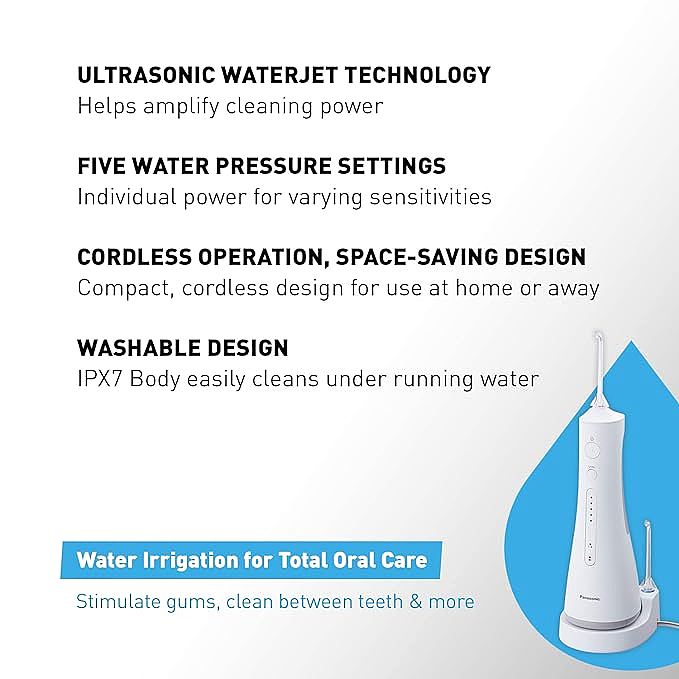
Devices like the Panasonic EW1511W Professional Cordless Water Flosser are not just hygiene tools; they are case studies in the miniaturization of hydraulic systems and electromechanical integration. This analysis explores the hidden engineering challenges behind the “cordless revolution” in oral care, examining how engineers balance energy density, ingress protection, and human factors to create autonomous health hardware.
The Cordless Imperative: Energy Density vs. Hydraulic Output
The primary challenge in creating a portable oral irrigator is power. Generating a water jet capable of dislodging plaque requires a high-torque motor driving a piston pump. In countertop units, AC power provides limitless energy. In a handheld unit, this energy must be stored chemically.
Lithium-Ion Chemistry and Discharge Rates
The viability of professional-grade cordless flossers hinges on the evolution of Lithium-Ion (Li-ion) battery technology. * High-Drain Capability: Unlike a remote control that sips power, a water flosser motor demands a high current draw (amperage) to maintain consistent pump pressure. If the voltage sags under load, the water pressure drops, and the cleaning efficacy is lost. Modern high-discharge Li-ion cells allow devices like the EW1511W to maintain a steady 1,600 pulses per minute even as the battery charge depletes, a feature known as “linear power delivery.” * Volumetric Energy Density: The critical metric is Watt-hours per liter (Wh/L). Engineers must fit enough energy capacity for multiple cleaning sessions (approx. 10 minutes of runtime) into a handle that fits comfortably in a human hand. The shift from Nickel-Metal Hydride (NiMH) to Li-ion allowed for a significant reduction in weight and size, enabling the slender profile of modern irrigators.
Inductive Charging and Sealed Systems
Integrating the charging mechanism poses another challenge. Traditional plug-in ports (USB or DC jacks) are vulnerable points for water ingress. * Contactless Power Transfer: To circumvent this, the EW1511W utilizes Inductive Charging. The base station contains a primary coil that generates an alternating electromagnetic field. The receiver coil inside the flosser handle converts this field back into electrical current to charge the battery. * Engineering Benefit: This allows the handle to be hermetically sealed. There are no exposed metal contacts to corrode (galvanic corrosion) from exposure to water and bathroom humidity, significantly extending the device’s lifespan in harsh environments.
The Challenge of Ingress Protection: Achieving IPX7
Electronics and water are mortal enemies. Short circuits, corrosion, and electrolytic migration can destroy a PCB (Printed Circuit Board) instantly. Yet, a water flosser must not only survive splashes but often complete submersion. The IPX7 rating—defined as the ability to withstand immersion in 1 meter of water for 30 minutes—is a rigorous engineering standard.
Sealing Methodologies
Achieving IPX7 in a device with moving parts (buttons, reservoir doors, nozzle rotation) requires a multi-layered defense strategy. * O-Ring Compression: Every interface where two distinct parts meet (e.g., the nozzle insertion point, the reservoir cap) must be sealed with elastomeric O-rings. The compression ratio of these rings is critical; too loose, and water enters; too tight, and the friction makes operation difficult. * Ultrasonic Welding: For the main body housing, manufacturers often use ultrasonic welding to fuse thermoplastic shells together. This creates a permanent, molecular bond that is impervious to water, superior to screws or glues which can degrade over time. * Conformal Coating: Even with perfect seals, condensation can form inside the unit due to temperature changes (e.g., a hot shower). To protect the sensitive electronics, the PCB is treated with a Conformal Coating—a thin polymeric film that insulates the components from moisture and conductive debris.
The Pressure Differential Problem
A unique challenge for water flossers is the internal pressure change. As the pump draws water from the reservoir, it creates a vacuum. If the reservoir were perfectly sealed, the pump would stall (cavitation lock). * Venting Solutions: Engineers must design a “breather valve” that allows air to enter the tank to replace the displaced water, but prevents water from leaking out. This is typically achieved using semi-permeable membranes (like Gore-Tex) or microscopic check valves that rely on surface tension to block liquid water while passing air molecules.
Hydraulic Miniaturization: The Pump Engine
Shrinking a countertop pump into a handheld cylinder requires a complete rethinking of the hydraulic architecture.
Piston vs. Diaphragm Pumps
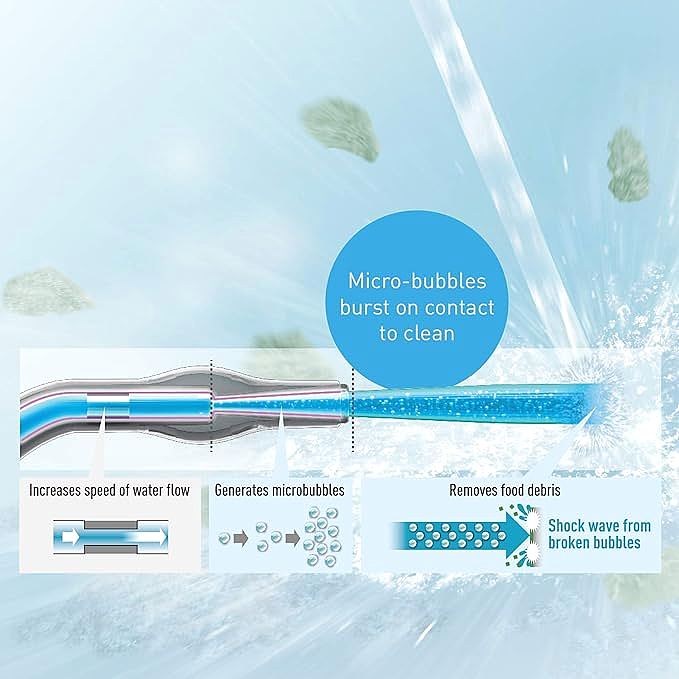
Most handheld units employ a reciprocating piston pump. * Mechanism: A DC motor spins an eccentric cam gear, which converts rotational motion into linear motion, driving a piston back and forth in a cylinder. * Efficiency: This mechanism is highly efficient at generating high pressure (up to 100 PSI) in a compact footprint. The “pulsation” characteristic of devices like the EW1511W is a direct mechanical byproduct of this piston stroke—pressure peaks during the compression stroke and drops during the intake stroke. * Ultrasonic Integration: To achieve ultrasonic frequencies (1,600+ Hz) superimposed on the hydraulic pulse, the nozzle geometry is often tuned to act as a resonance chamber, amplifying the turbulence and bubble formation without requiring a separate ultrasonic transducer.
Human Factors and Haptics: The Ergonomics of Use
Engineering specifications are meaningless if the device is unusable. The shift to handheld formats places a heavy burden on Human Factors Engineering.
Center of Gravity and Grip Dynamics
A full water reservoir adds significant weight (approx. 200g of water). If the center of gravity is too high (away from the hand), the device feels top-heavy and unwieldy, causing wrist fatigue. * Mass Distribution: The EW1511W places the heavy components—the battery and motor—central to the grip area, while the water reservoir wraps around or sits below. This neutral balance allows for precise manipulation of the nozzle tip inside the mouth. * Tactile Feedback: The grip surface must provide traction even when wet and soapy. This involves texturing the plastic or over-molding with thermoplastic elastomers (TPE). * Blind Operation: Oral irrigation happens with the device inside the mouth, often while leaning over a sink. The user cannot see the buttons. The control interface must be designed for “blind operation,” using distinct tactile reliefs or concave/convex button shapes so the user can switch modes or turn the unit off purely by feel.
The Compliance Equation: Tech as a Behavior Driver
Ultimately, the goal of this hardware evolution is Patient Compliance. Dental professionals know that the best tool is the one the patient actually uses. * Removing Friction: The cordless design removes the “friction” of setup—uncoiling hoses, finding an outlet, filling a massive tank. By making the device “grab-and-go,” engineering directly influences behavior frequency. * Travel Readiness: The portability allows oral hygiene routines to continue during travel, breaking the cycle of neglect that often occurs during vacations or business trips.
Conclusion: The Synthesis of Disciplines
The modern cordless water flosser is a triumph of interdisciplinary engineering. It represents the convergence of fluid dynamics, electrochemistry, materials science, and industrial design. Devices like the Panasonic EW1511W demonstrate that we do not need to sacrifice power for portability. Through the intelligent application of Li-ion energy, inductive power transfer, and precision micromachining, we have miniaturized the dental clinic, placing professional-grade hydraulic capability into the palm of the hand. This is not just a gadget; it is the democratization of advanced healthcare hardware.


