Decoding the Dial: The Science Behind Toaster Browning Levels and Functions
Update on Nov. 9, 2025, 1:35 p.m.
It is a universally acknowledged frustration: the breakfast paradox. You place a slice of bread into the toaster, select a medium setting, and receive either a piece of lukewarm, pale bread or a blackened, smoking crisp. Achieving the perfect, edge-to-edge golden-brown toast can feel like a game of chance.
This inconsistency is especially concerning when investing in a new appliance, particularly one chosen for its aesthetic, like a retro-style toaster. The fear, as user reviews for many models often confirm, is that a beautiful exterior may hide substandard performance, with complaints of settings that “burn toast… even at the lowest setting.”
But what if the problem isn’t entirely the toaster? What if it’s a misunderstanding of the complex chemistry at play?
Toasting is not merely “drying” or “burning”; it is a delicate and rapid chemical process. Modern toasters, from basic models to stylish retro units, are engineered with specific features designed to control this very process. By decoding the science behind the settings, you can move from guesswork to mastery.
The Alchemy of Breakfast: Toast and the Maillard Reaction
The transformation of soft bread into crisp toast is governed by a chemical cascade known as the Maillard reaction. This is the same process responsible for the browning of a seared steak or the crust of baked bread.
When the bread’s surface temperature rises above approximately 284°F (140°C), the amino acids (from protein) and reducing sugars (from carbohydrates) begin to react. This reaction creates hundreds of new flavor and aroma compounds, as well as melanoidins, the pigments responsible for the characteristic golden-to-dark-brown color.
This reaction is highly sensitive. Its outcome depends on several variables:
- Bread Type: A bread high in sugar and protein, like a brioche or challah, will brown much faster than a lean sourdough or rye.
- Moisture Content: Drier, older bread will toast faster than a fresh, moist slice.
- Initial Temperature: A slice of frozen bread and a room-temperature slice will have vastly different toasting times.
This explains why a single browning level (e.g., “Level 3”) will produce dramatically different results on different types of bread. As one user noted, “a 2 setting resulted in a nicely toasted slice, represented by a 4 or 5 setting in the instruction manual.” This isn’t a defect; it’s a variable of food chemistry. The six-level browning dial on a toaster is not an absolute measure of “doneness” but rather a timer that controls the duration of heat exposure, allowing you to calibrate the Maillard reaction based on the bread you’re using.
Engineering Consistency: How Toasters Tame the Chaos
While the chemistry is variable, appliance engineers have developed features to impose consistency. The goal is to deliver uniform heat to the entire surface of the bread, which is more challenging than it sounds.
The Wide-Slot Solution
A primary cause of uneven toasting is improper slot spacing. In a narrow slot, a thick slice of bread or a bagel gets pressed directly against the heating elements in some spots while other areas are too far away. This results in scorched stripes next to pale, untoasted patches.
The engineering solution is the 1.5-inch extra-wide slot, a design now common in many 4-slice toasters. These wider slots (often 5.5 inches long) create a more forgiving heat chamber. They allow thicker cuts, like Texas toast or artisan sourdough, to sit centered. This spacing promotes more uniform heat transfer, relying less on direct, harsh conduction and more on infrared radiation from the elements and hot air convection circulating within the slot. The result is a more evenly browned surface.

The Dual-Control Difference
In a household with different preferences, a single-control toaster is a bottleneck. One person wants a light, golden English muffin, while another wants a dark, crispy bagel. This forces users to toast in sequence, constantly resetting the browning level.
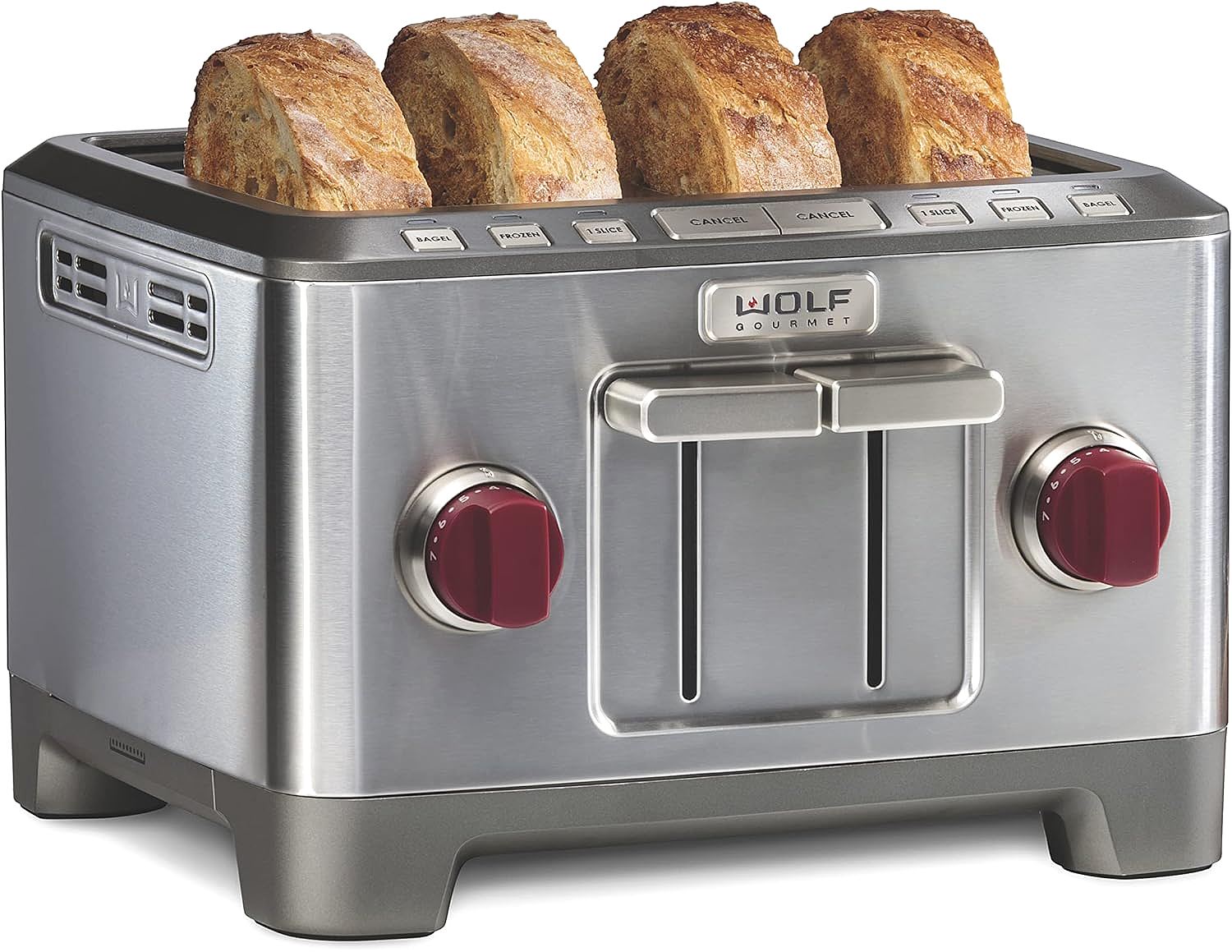
The implementation of dual independent control panels on 4-slice models, such as the Roter Mond retro toaster, elegantly solves this. Functionally, this design turns one appliance into two. Each pair of slots operates on its own circuit, with its own browning dial and function buttons. This allows for two different “recipes”—for example, a “Level 2, Bagel” setting on one side and a “Level 5, Bread” setting on the other—to run simultaneously. It’s an engineering solution that directly addresses the logistical (and relational) friction of a shared breakfast routine.

Beyond the Dial: Decoding Your Toaster’s Smart Functions
Modern toasters have moved beyond a simple on/off timer. The function buttons with LED indicators (Bagel, Defrost, Reheat) are not gimmicks; they are pre-programmed overrides that alter the toasting cycle to solve specific problems.
- Bagel Function: This is the most misunderstood feature. A bagel should not be toasted on both sides; the goal is a crisp, browned cut side and a warm, chewy crust. The “Bagel” setting achieves this through asymmetrical heating. It turns off (or significantly lowers the power to) the outer heating elements while fully energizing the inner elements, directing the majority of the heat to the cut surfaces.
- Defrost Function: Toasting frozen bread directly on a normal setting is the primary cause of the “burnt outside, frozen inside” syndrome. The “Defrost” function’s program first initiates a longer, lower-power cycle to gently thaw the bread. Once the toaster’s internal logic determines the bread is thawed, it automatically transitions into the standard browning cycle you selected.
- Reheat Function: This is a rescue mission for a forgotten slice of toast. It provides a very short, low-intensity burst of heat—just enough to warm the finished toast back to an appetizing temperature without re-starting the Maillard reaction and browning it further.
- Cancel Function: The essential escape hatch. It allows you to interrupt any cycle the moment you see, smell, or hear that the toast is done, giving you the final say over the machine.
Practical Design: The Unsung Features That Matter
Beyond the complex heating technology, the usability and safety of a toaster are defined by its physical design. These are the features that impact the daily experience.
The High-Lift Lever
Retrieving smaller items like English muffins or crumpets often involves a risky reach into hot slots with fingers or, perilously, a fork. A high-lift lever is a simple, crucial safety mechanic. After the toast automatically pops up, this feature allows the user to manually push the carriage an extra half-inch or more, bringing the toast clear of the hot opening for safe retrieval.

Material Science and Maintenance
The choice of materials is not just about looks. A stainless steel chassis and slots, common in both professional and quality consumer models, provides durability, resists rust, and won’t impart flavors. Its smooth surface is also hygienic and easy to wipe clean. Furthermore, the use of BPA-free materials in food-contact components addresses modern health concerns about chemical leaching, ensuring the appliance is safe for family use.
Finally, maintenance is a matter of fire safety. All toasting creates crumbs, which accumulate at the bottom of the toaster. If left unchecked, these crumbs can ignite. A removable crumb tray (or dual trays in a 4-slice model) is a non-negotiable feature. These trays slide out, allowing you to quickly and easily dispose of debris, keeping the appliance clean and reducing fire risk.

The appeal of a retro toaster, with its polished curves and nostalgic colors, is undeniable. But this aesthetic is no longer an excuse for poor performance. Appliances like the Roter Mond 4 Slice Retro Toaster serve as functional case studies, demonstrating how modern engineering—from wide-slot physics and dual-control circuitry to intelligent defrost cycles—is packaged within that charming design. Understanding the science inside the machine is the key to mastering it, allowing you to finally end the breakfast paradox and get the perfect slice of toast, every single time.