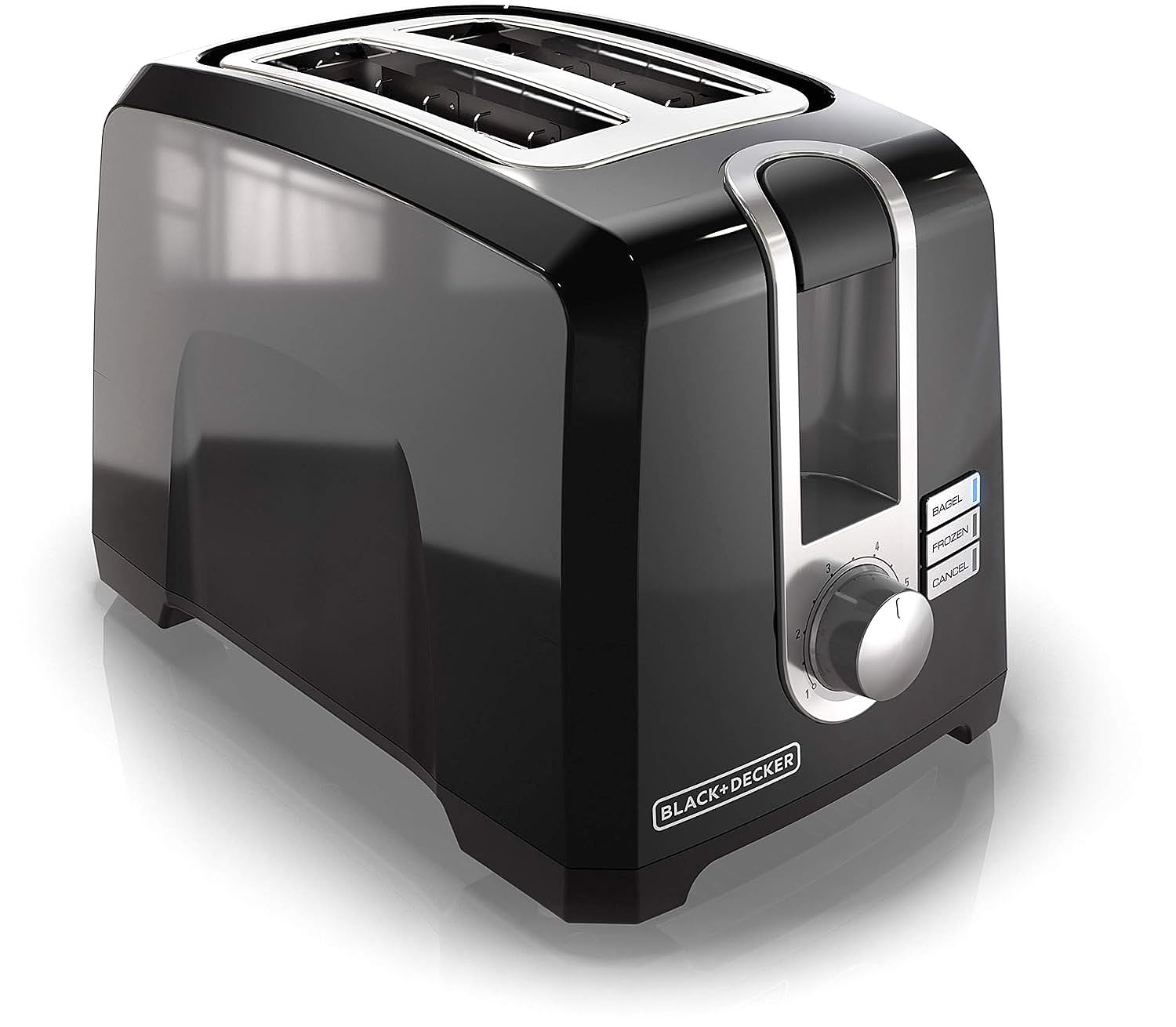
BLACK+DECKER TR0011SSA 2-Slice Toaster: The Best Choice for Thick Bread Slices
Update on Sept. 19, 2025, 10:27 a.m.
It’s a smell that can define a morning. That warm, nutty, slightly sweet aroma of perfectly toasted bread wafting from the kitchen. It’s a universal signal of comfort, a simple pleasure that starts the day on the right note. We push down a lever, wait for the satisfying pop, and are rewarded with a slice of golden-brown perfection.
But have you ever truly considered the alchemy happening inside that unassuming metal box on your counter? What transforms a soft, pale slice of bread into a crisp, flavorful delight? It’s not magic, and it’s far more intricate than simply “burning it a little.” It’s a carefully orchestrated dance of chemistry, physics, and ingenious engineering. Let’s pull back the curtain.

The Chemistry of Deliciousness: It’s Not Burning, It’s Art
First, let’s get one thing straight: the beautiful brown color and complex flavor of toast are not the results of simple burning (carbonization). They are the product of a magnificent chemical process known as the Maillard reaction.
Named after French chemist Louis-Camille Maillard, who first described it in the early 20th century, this reaction is the secret behind the flavor of countless foods, from seared steaks and roasted coffee to fried onions. It’s a non-enzymatic browning that occurs when amino acids (the building blocks of proteins) and reducing sugars are subjected to heat, typically above 285°F (140°C).
Think of it as a culinary re-arrangement. The heat encourages these molecules to dance, break apart, and recombine into hundreds of new, wonderfully aromatic compounds. This is what creates the rich, savory, and roasted notes that make toast so irresistible. It’s a delicate process. Too little heat, and the bread remains bland and doughy. Too much, and you bypass the Maillard sweet spot, heading into a bitter, burnt territory.
This precision is key. In fact, pushing the Maillard reaction too far at high temperatures can lead to the formation of acrylamide, a compound you’re better off minimizing. The art of the perfect toast, therefore, is the art of controlling this reaction with precision. Which brings us to the machine itself.

The Heart of the Heat: Taming Electricity with a “Traffic Jam”
How does a toaster generate the intense heat needed to kickstart this chemical ballet? The answer lies in a fundamental principle of physics: Joule heating, or resistive heating.
Imagine electricity flowing through a copper wire as cars cruising down a wide, open highway. The flow is smooth and effortless. Now, imagine that highway suddenly narrows into a single, bumpy lane. Traffic would immediately back up, cars would jostle, and a great deal of friction and heat would be generated.
This is exactly what happens inside a toaster. The heating elements you see glowing red are not made of copper. They are typically made of an alloy called nichrome (mostly nickel and chromium). Nichrome wire is the “narrow, bumpy lane” for electricity. It has a much higher electrical resistance than copper, meaning it actively fights the flow of current. This struggle converts electrical energy directly into heat energy. The result is a wire that can safely and quickly reach temperatures hot enough to toast bread.
You might notice these wires are always coiled. This is a simple but brilliant piece of engineering. To get enough resistance to generate sufficient heat, you need a surprisingly long piece of nichrome wire. Coiling it allows that length to be packed into the compact space of a toaster slot, ensuring the entire surface of the bread is bathed in radiant heat.

The Brain of the Machine: Not a Clock, But a Clever Bend
So, the toaster is glowing hot. But how does it know when to stop? How does it differentiate between a light golden-brown and a deep, dark crisp? Most people assume there’s a simple timer inside, counting down the seconds. The truth is far more elegant and entirely mechanical.
The secret lies in a device called a bimetallic strip.
A bimetallic strip is made of two different metals—typically steel and brass—bonded together. Crucially, these two metals expand at different rates when heated.
When you press the toaster lever down, you complete an electrical circuit, sending power to the nichrome elements. At the same time, this circuit also begins to gently heat the bimetallic strip. As it warms up, the brass side expands more than the steel side. Since they are fused together, this uneven expansion forces the strip to bend.
It bends slowly and predictably. The dial on your toaster, the one with settings from 1 to 7, doesn’t control a timer. It controls the position of a catch. It essentially tells the bimetallic strip how far it needs to bend before it triggers the release mechanism. A light setting requires only a small bend; a dark setting requires the strip to get hotter and bend much further.
Once the strip bends enough to hit the trigger, the circuit is broken, the power to the heating elements is cut, and pop—the toast carriage is released. It’s a beautifully simple, analog solution to a control problem, a relic of clever mechanical engineering that persists even in our digital age.

Engineering for the Perfect Slice
This mastery of chemistry and physics is then refined by thoughtful design. When you look at a well-designed modern toaster, like a BLACK+DECKER TR0011SSA, you’re seeing the application of these principles for a perfect user experience.
The extra-wide, self-centering slots, for instance, are not just for accommodating bagels. They are a solution to an infrared radiation problem. By holding the slice perfectly in the middle, equidistant from the heating elements on both sides, they ensure that the bread receives an even dose of radiant heat. This prevents the dreaded half-toasted, half-pale slice.
The stainless steel exterior is more than just a stylistic choice. It’s a nod to material science. Stainless steel is a poor conductor of heat compared to other metals, which helps to keep the exterior from becoming dangerously hot. It’s also corrosion-resistant, thanks to a microscopic layer of chromium oxide that self-heals, ensuring the appliance remains a durable fixture in your kitchen.
Even the high-lift lever is a small piece of applied physics, using mechanical advantage to safely lift smaller items away from the hot slots.

Your Kitchen is a Laboratory
So, the next time you stand in your kitchen, waiting for that familiar pop, take a moment. The simple act of making toast is a testament to human ingenuity. It’s a device that harnesses the raw power of electricity through the principle of resistance, uses it to initiate a complex flavor-generating chemical reaction, and controls the entire process with a clever piece of 19th-century mechanical physics.
Your toaster isn’t just an appliance. It’s a miniature laboratory, a silent, glowing monument to the science that underpins our daily lives. And understanding that makes every perfectly golden-brown slice taste just a little bit more satisfying.