The Unsolved Case of the Perfect Toast: An Investigation Into the Science of Your Toaster
Update on Oct. 2, 2025, 4:15 p.m.
It is a crime scene familiar to millions. The time: early morning. The evidence: a slice of bread, once promising, now a victim of uneven heating. One side bears the ghostly pale of underdevelopment, while the other is a charred ruin, a testament to excessive force. The air hangs thick with the scent of carbon and disappointment. This small, domestic tragedy is, according to data from years of consumer appliance surveys, one of the most persistent and frustrating grievances in the modern kitchen. The toaster, a seemingly simple device, remains a notoriously unreliable servant. The central question of this investigation is as simple as it is perplexing: in an age of precision engineering, why is a perfect slice of toast so maddeningly elusive?
This is not a trivial matter. The pursuit of that uniform, golden-brown, crisp-yet-tender slice is a quest to control a cascade of complex chemical and physical events. To solve this mystery, we must approach it not as cooks, but as forensic investigators. We must delve into the fundamental laws of nature that govern the case, conduct a thorough autopsy of a modern suspect, and identify the true culprit behind our breakfast-time felonies. The truth, it turns out, is a fascinating story of engineering ambition colliding with the stubborn realities of physics.

The Science Lab: The Unseen Forces of Flavor
Before we can analyze the instrument of the crime, we must understand the forces it is designed to wield. The transformation of bread into toast is governed by two fundamental principles, one of chemical desire and one of physical means. The motive, the entire reason we engage in this act, is a beautiful process known as the Maillard reaction. This is not burning; it is creation. When the surface of bread climbs above approximately 300°F, its amino acids and sugars begin a chaotic, magnificent recombination, forging hundreds of new molecules that generate the rich, nutty, and deeply savory flavors we crave. As research in food science journals confirms, the speed and character of this reaction are intensely sensitive to the bread’s specific composition—its moisture, its sugar content, and even its pH level. A tangy, dense sourdough presents a very different chemical canvas than a soft, sweet brioche, demanding a different application of heat to achieve its peak flavor potential.
The method by which this chemical motive is achieved is a matter of pure physics: heat transfer. The toaster employs a two-pronged attack. First is infrared radiation, the ghostly red glow from the heating elements. Like miniature suns, these coils beam energy directly into the bread, causing its internal water molecules to vibrate and generate heat from within. This is the source of the deep, thorough cooking. Simultaneously, conduction occurs where the bread’s surface is in close proximity to the hot coils, directly transferring thermal energy to create the desirable surface crispness. The perfect slice of toast is the result of these two physical methods working in concert, delivering just enough energy to bring the Maillard reaction to its glorious peak without tipping it over the edge into incineration. These, then, are the laws of our case: a sensitive chemical reaction and a dual-fronted physical assault.

The Autopsy of the Machine: Deconstructing a Modern Suspect
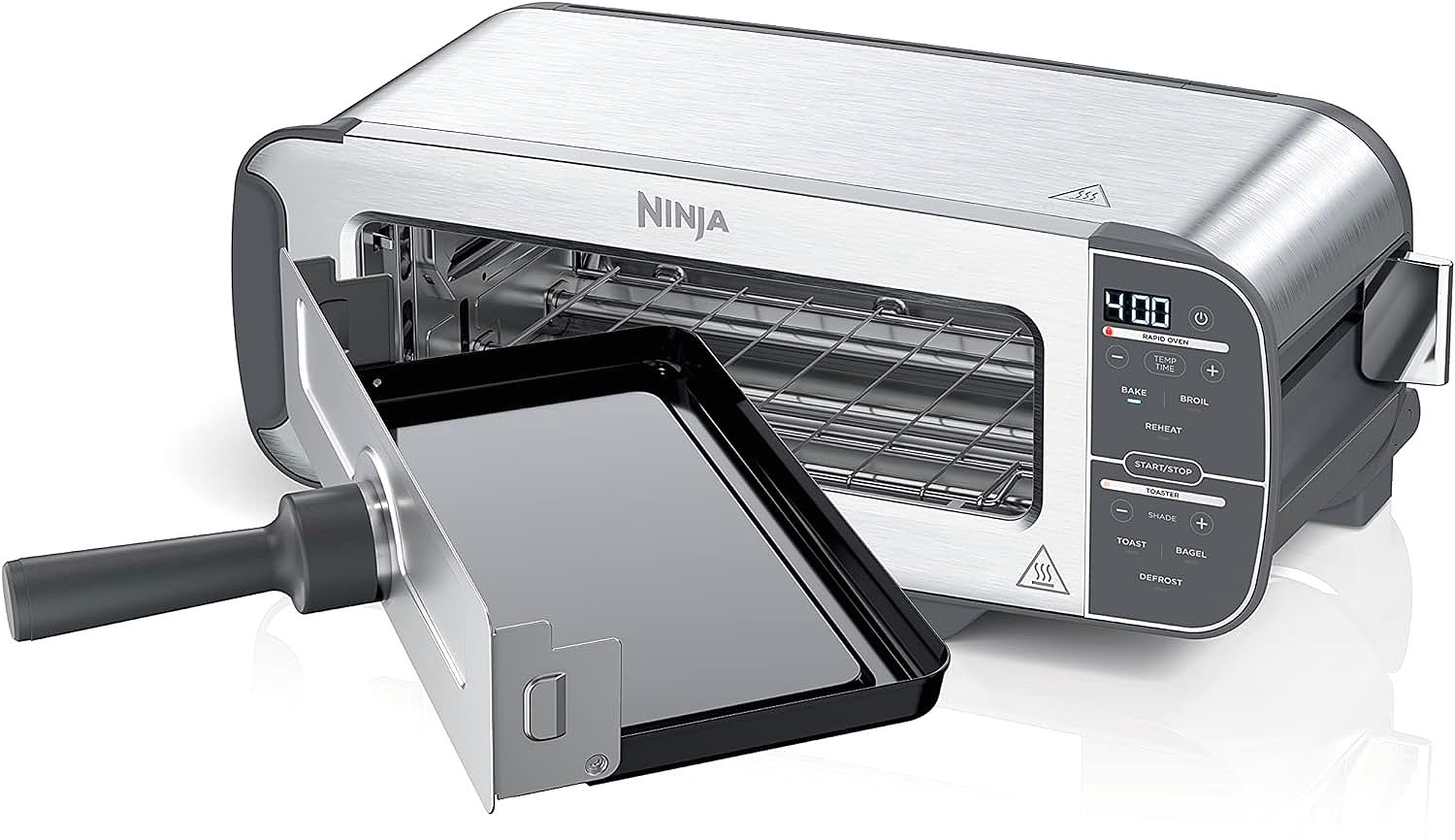
We have established the laws of nature that govern this case. Now, we must turn our attention to the instrument itself. Let us place a modern suspect, the JOY Kitchen JTO4NBM180 Digital Countertop Toaster, on the examination table. Our goal is not to offer a verdict on its quality, but to perform a forensic teardown, to understand how its design attempts to manipulate these fundamental forces of chemistry and physics with precision.
Our autopsy begins with its most prominent feature: the digital control system. We can call this The Brain. In older, analog toasters, the timing was governed by a crude bimetallic strip that would bend with heat until it physically tripped a switch—a mechanism prone to fatigue and inconsistency. The JTO4NBM180’s digital countdown timer represents a quantum leap in control. It has, in essence, solved the temporal problem of toasting. It allows for a precise, repeatable duration of energy application, measured in seconds. This brain offers the promise of consistency, a critical first step in taming the chaos.
Next, we examine The Tools, the specialized functions that suggest an awareness of the victim’s diverse nature. The “Defrost” setting is more than a simple thawing mechanism. As principles from food engineering explain, toasting frozen bread is a challenge of managing water migration. A blast of high heat would scorch the surface while the interior remains a frozen, doughy mass. The defrost cycle uses a lower-power, often pulsed, application of heat to gently melt the ice crystals and allow that moisture to distribute evenly before the main toasting cycle begins, preventing a disastrous outcome. The “Bagel” function, meanwhile, is a clever solution to an asymmetrical problem. It diverts more power to the heating elements facing the cut-side of the bagel, concentrating the Maillard reaction where it’s most desired, while only gently warming the rounded crust. These tools show a sophisticated understanding of the scientific challenges at hand.
Finally, we consider The Arena where the act takes place. The 1.49-inch extra-wide slots are a direct engineering response to the changing profile of the bread itself. The era of the thin, uniform sandwich slice is over. Today’s victims are often thick-cut artisan loaves, dense sourdoughs, and bulky bagels. A narrow arena would cause the bread to be too close to the heating elements, resulting in scorching. These wider slots provide necessary clearance, allowing the gentler, more forgiving power of infrared radiation to do its work more effectively. On paper, our suspect appears to be a highly evolved predator: a precise brain, specialized tools, and a well-designed arena. It seems capable of flawless execution.

The Smoking Gun: A Forensic Analysis of the Heating Element
The autopsy reveals a suspect with a sophisticated brain and a versatile set of tools. Yet, the crime of uneven toasting persists across the nation. This paradox suggests the key evidence lies not in the controls we can see, but in the fiery heart of the machine itself—the heating element. It’s time to analyze the weapon.
The glowing coils in almost every consumer toaster are made from an alloy called Nichrome. It is a remarkable material, capable of withstanding immense heat without oxidizing. But it is also the source of the toaster’s most intractable problem. Expert technical manuals on Nichrome reveal a crucial fact: its electrical resistance, and therefore its heat output, is directly affected by fluctuations in your home’s voltage. A slight dip or surge in power, imperceptible to you, can cause the coils to run hotter or cooler than intended, throwing off the precise calculations of the digital brain. Furthermore, over hundreds of heating and cooling cycles, the material itself degrades, its resistance subtly changing. The heating element is, in forensic terms, an unreliable witness, its testimony changing slightly every time it is called upon.
This, however, is not even the most critical flaw. The true smoking gun is the spatial problem. The Nichrome wire or ribbon is wound around sheets of mica to form the heating grids. In a perfect world, this winding would be flawlessly uniform, creating a perfectly even field of infrared radiation. But in the world of mass manufacturing, this is a near impossibility. Microscopic variations in the spacing of the coils are inevitable, creating permanent hot spots and cold spots across the heating grid. You can have the most precise timer in the world, but if the weapon itself has inherent flaws—if the heat source is fundamentally non-uniform—the result will never be perfect. This is the stubborn, physical truth at the heart of the mystery. The digital controls master the dimension of time, but they have almost no authority over the dimension of space.

The Verdict: Engineering on a Knife’s Edge
The conclusion of our investigation is therefore clear. The primary culprit for inconsistent toast is not a single faulty design or a lapse in quality control, but the inescapable physical limitations of the materials and manufacturing processes employed at a consumer price point. The ambition for perfection runs headfirst into the wall of physics.
The JOY Kitchen toaster, and its digital peers, represents a brilliant solution to one half of the problem. It has largely tamed the temporal chaos of toasting, offering a level of precision and repeatability that was unimaginable with older technologies. This is a genuine and significant advancement. However, the spatial problem—the challenge of projecting a perfectly uniform plane of heat onto an irregularly shaped, chemically diverse piece of bread—remains largely unsolved. This is the great trade-off of modern appliance engineering. A perfect solution exists—one could imagine a toaster with dozens of sensors and individually controlled heating zones, like a professional pizza oven—but it would cost ten times as much.

For the home detective, this knowledge is power. Understanding the weapon’s inherent flaws allows for mitigation. Centering the bread slice perfectly in the slot, for instance, becomes a critical act, ensuring it receives as even a dose of radiation as possible. Using a slightly lower setting and toasting for a second cycle can sometimes produce a more even result by allowing the heat to penetrate more gently. You are, in effect, compensating for the machine’s imperfections with your own superior knowledge of the case.

The Case Is Never Truly Closed
Looking ahead, the case of the perfect toast is far from closed. Engineers are experimenting with new technologies, from quartz and halogen heating elements that offer a more uniform energy profile, to smart toasters equipped with optical sensors that can read the color of the bread in real-time and shut down at the precise moment of golden-brown perfection. But until those technologies become mainstream, the toaster in your kitchen remains a fascinating microcosm of all technological endeavor. It is a constant, imperfect, and brilliant struggle to impose digital order on the gloriously messy and chaotic laws of the physical world. It is the art of engineering, played out on a knife’s edge between triumph and a burnt breakfast.